When the Sun Hits This Point We Can Drink Again
The sun is the closest star to World. Fifty-fifty at a altitude of 150 million kilometers (93 meg miles), its gravitational pull holds the planet in orbit. It radiates light and heat, or solar energy, which makes it possible for life to exist on Globe.
Plants demand sunlight to abound. Animals, including humans, need plants for nutrient and the oxygen they produce. Without heat from the sun, World would freeze. There would be no winds, ocean currents, or clouds to transport water.
Solar energy has existed as long as the dominicus—near 5 billion years. While people have not been around that long, they have been using solar energy in a diversity of ways for thousands of years.
Solar energy is essential to agriculture—cultivating land, producing crops, and raising livestock. Developed most x,000 years ago, agriculture had a key role in the ascent of civilisation. Solar techniques, such equally ingather rotation, increased harvests. Drying nutrient using sun and wind prevented crops from spoiling. This surplus of nutrient allowed for denser populations and structured societies.
Early civilizations around the world positioned buildings to face southward to gather heat and calorie-free. They used windows and skylights for the aforementioned reason, as well every bit to allow for air circulation. These are elements of solar architecture. Other aspects include using selective shading and choosing building materials with thermal mass, meaning they store heat, such as stone and concrete. Today, computer programs make applications easier and more precise.
The greenhouse is some other early solar evolution. By converting sunlight to heat, greenhouses make it possible to grow plants out of season and in climates that may non exist suited for them. One of the earliest greenhouses dates to xxx CE, before glass was even invented. Constructed from translucent sheets of mica, a thin mineral, information technology was congenital for the Roman emperor Tiberius, who wanted to be able to eat cucumbers all twelvemonth. The general technique is the same today, although there take been many improvements to increase the variety and amount of crops grown.
One time nutrient is harvested, solar energy can be used to cook it. The first solar box cooker was built in 1767 by Horace de Saussure, a Swiss physicist. It reached temperatures of 87.8 degrees Celsius (190 degrees Fahrenheit) and was used to melt fruit. Today, there are many different types of solar cookers being used for cooking, drying and pasteurization, which slows the growth of microbes in food. Because they do non utilize fossil fuels, they are safety, do not produce pollution or cause deforestation.
Solar cookers are used in many parts of the earth in growing numbers. It is estimated that there are half a 1000000 installed in Republic of india alone. Bharat has the globe'south two largest solar cooking systems, which can prepare food for 25,000 people daily. According to Indian Prime Minister Manmohan Singh, "Since exhaustible energy sources in the land are express, there is an urgent need to focus attention on development of renewable energy sources and utilise of energy efficient technologies."
In Nicaragua, a modified solar cooker is being used to sterilize medical equipment at clinics.
Solar thermal free energy tin can be used to heat water. First introduced in the late 1800s, the solar water heater was a large improvement over stoves that burned wood or coal because it was cleaner and toll less to operate. They were very popular for American homes in sunny places, including Arizona, Florida, and California. However, in the early 1900s, low-toll oil and natural gas became available and solar h2o systems began to exist replaced. Today, they are not but popular over again; they are becoming the norm in some countries, including China, Greece, and Nippon. They are fifty-fifty required to be used in whatever new construction in Commonwealth of australia, State of israel, and Espana.
Also heating water, solar free energy can exist used to make it potable, or suitable for drinking. One method is solar disinfection (SODIS). Developed in the 1980s, SODIS involves filling plastic soda bottles with water so exposing them to sunlight for several hours. This process reduces the viruses, bacteria and protozoa in water. More than than 2 million people in 28 developing nations use this method daily for their drinking h2o.
Solar ability—the conversion of sunlight into electricity—is however another application of solar engineering science. This tin can exist washed in a number of ways. The two almost common are photovoltaic (solar cells) and concentrating solar power.
Solar cells convert sunlight direct into electricity. The amount of power generated by each cell is very low. Therefore, large numbers of cells must be grouped together, like the panels mounted on the roof of a house, to generate enough power.
The first solar cell was synthetic in the 1880s. The earliest major application was on the American satellite Vanguard I, launched in 1958. A radio transmitter powered by solar cells operated for about vii years; 1 using conventional batteries lasted only 20 days. Since and so, solar cells take become the established power source for satellites, including those used in the telecommunications manufacture.
On Earth, solar cells are used for everything from calculators and watches to homes, commercial buildings, and even stadiums. Kaohsiung World Stadium in Taiwan, completed in 2009 to host the Globe Games, has more than viii,800 solar panels on its roof. Charles Lin, director of Taiwan's Bureau of Public Works, said, "The stadium'south solar energy panels volition make the venue self-sufficient in electricity needs." When the stadium is non in use, it can ability lxxx percent of the surrounding neighborhood.
Dissimilar solar cells, which use sunlight to generate electricity, concentrating solar power engineering uses the sunday's heat. Lenses or mirrors focus sunlight into a small beam that can be used to operate a boiler. That produces steam to run turbines to generate electricity. This method will be used at the Solana Generating Station, which is being built past the APS utility company outside of Phoenix, Arizona, in the United States. When completed in 2012, Solana will be one of the largest solar power stations in the world. Once operating at full capacity, it volition serve 70,000 homes.
"This is a major milestone for Arizona in our efforts to increase the amount of renewable free energy available in the United States," said old Arizona Gov. Janet Napolitano.
In that location are some challenges with solar power. First, it is intermittent, or not continuous. When there is no sun—at nighttime, for example—ability cannot be generated. In order to provide continuous ability, either storage or other free energy sources, such as wind power, must be used. Second, while both photovoltaic and concentrating solar power can be used almost anywhere, the equipment they require takes up a lot of space. Installation, except for on existing structures, tin can have a negative impact on the ecosystem by displacing plants and wildlife. Lastly, the cost to collect, convert and store solar power is very high. However, as technological advancements are made and demand rises, the costs are dropping.
Fossil fuels, such as coal, oil and natural gas, currently produce near of our electric and engine power. They also produce nigh all of our pollution. Plus, they are not-renewable, significant there is a limited supply.
The sun, on the other mitt, offers gratis and clean free energy in abundance. In fact, information technology gives much more energy than we can ever mayhap apply. The only questions are how and when we volition take full advantage of it.
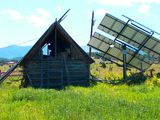
The solar panel to the right probably can't help provide electricity to the shack on the left, but it tin assistance lower the energy costs for the neighborhood.
Photograph by Pamela Dean, MyShot
African Free energy
16,000 foursquare kilometers (nine,942 square miles) of solar power plants in N Africa could generate enough electricity for all of Europe.
Electrified Nation
Ranked 3rd in the world in population, the United states of america uses more than electricity than whatsoever other country, even the entire European Union of 27 nations.
Solar Ability
In fifteen minutes, the sun radiates as much free energy every bit people use in all forms in an entire year.
Substantive
the art and science of cultivating land for growing crops (farming) or raising livestock (ranching).
autoclave
Substantive
an airtight, steam-heated device used to sterilize medical instruments.
Plural Substantive
(singular: bacterium) single-celled organisms found in every ecosystem on World.
CE
Describing word
Mutual Era. CE designates the years following ane BCE, including the current year.
Noun
complex way of life that developed equally humans began to develop urban settlements.
climate
Noun
all weather conditions for a given location over a period of fourth dimension.
Noun
visible mass of tiny water aerosol or ice crystals in Earth's temper.
Noun
dark, solid fossil fuel mined from the earth.
convert
Verb
to change from 1 affair to some other.
Noun
agricultural produce.
ingather rotation
Noun
the arrangement of changing the blazon of crop in a field over time, mainly to preserve the productivity of the soil.
cultivate
Verb
to set and nurture the state for crops.
Substantive
steady, predictable flow of fluid within a larger body of that fluid.
Noun
devastation or removal of forests and their undergrowth.
dense
Adjective
having parts or molecules that are packed closely together.
developing world
Noun
nations with low per-capita income, little infrastructure, and a small eye class.
Noun
our planet, the third from the Sun. The Earth is the only place in the known universe that supports life.
Noun
community and interactions of living and nonliving things in an area.
electricity
Noun
set of physical phenomena associated with the presence and flow of electrical charge.
essential
Adjective
needed.
fossil fuel
Noun
coal, oil, or natural gas. Fossil fuels formed from the remains of ancient plants and animals.
gravitational pull
Noun
physical allure between ii massive objects.
greenhouse
Noun
building, often made of glass or other articulate fabric, used to help plants grow.
harvest
Substantive
the gathering and collection of crops, including both plants and animals.
Horace de Saussure
Noun
(1740-1799) Swiss scientist and mountain climber.
installation
Noun
placing or setting up for use.
intermittent
Adjective
starting and stopping, not consistent.
livestock
Noun
animals raised for human utilize.
Manmohan Singh
Noun
prime minister of Bharat since 2004.
mica
Noun
blazon of mineral that can be split into thin, see-through sheets.
microbe
Substantive
tiny organism, usually a bacterium.
mount
Verb
to climb upwardly or go on top of.
Noun
type of fossil fuel made up mostly of the gas methane.
oil
Noun
fossil fuel formed from the remains of marine plants and animals. Likewise known as petroleum or rough oil.
oxygenate
Verb
to fill up with oxygen.
pasteurize
Verb
to heat a liquid to a high temperature to destroy harmful microorganisms.
photovoltaic
Adjective
able to convert solar radiations to electrical energy.
Noun
introduction of harmful materials into the environment.
population
Noun
total number of people or organisms in a particular area.
potable
Adjective
suitable for drinking.
protozoa
Substantive
1-celled organisms in the kingdom protista, such every bit amoebas. (singular: protozoan)
radiate
Verb
to motility outward from a central spot.
radio transmitter
Noun
device that sends out audio signals.
renewable energy
Noun
energy obtained from sources that are virtually inexhaustible and replenish naturally over small fourth dimension scales relative to the homo life span.
Roman emperor
Substantive
supreme ruler of aboriginal Rome in its imperial period (the Roman Empire) from 27 BCE to the autumn of the empire in 476 CE.
society
Noun
large customs, linked through similarities or relationships.
solar architecture
Noun
the planning and blueprint of buildings to make the most use of the sun's heat and light.
solar cooker
Noun
oven that uses sunlight to heat food.
Noun
radiations from the sun.
solar power
Substantive
charge per unit of producing, transferring, or using solar energy.
southward
Noun
management to the right of a person facing the rise sun.
spoil
Verb
to rot or ruin.
star
Substantive
large ball of gas and plasma that radiates free energy through nuclear fusion, such as the sun.
Noun
star at the center of our solar system.
surplus
Noun
more than than what is needed or wanted.
telecommunications
Noun
the science and engineering of sending and receiving information over long distances using electric, radio, or low-cal signals.
thermal mass
Substantive
the power of a substance or structure to store heat.
Tiberius
Substantive
(42 BCE-37 CE) second emperor of the Roman Empire.
translucent
Describing word
nigh clear.
turbine
Noun
machine that captures the free energy of a moving fluid, such as air or water.
Vanguard I
Noun
(1958) oldest satellite still in orbit, and the first that was solar-powered.
virus
Substantive
pathogenic agent that lives and multiplies in a living cell.
Noun
movement of air (from a high pressure level zone to a depression force per unit area zone) caused by the uneven heating of the Earth by the dominicus.
Source: https://www.nationalgeographic.org/article/power-sun/
0 Response to "When the Sun Hits This Point We Can Drink Again"
Post a Comment